
Can Professional Couch Cleaning Remove Cat Urine Smell?
Yes, professional couch cleaning can often remove or significantly reduce cat urine smell. The final result depends on how much urine reached
For most Phoenix homes, professional luxury vinyl plank flooring installation typically costs about $4 to $10 per square foot for materials and standard installation. A 1,500-square-foot project may cost roughly $6,000 to $15,000, depending on the product, existing flooring, and preparation required.
Not every per-square-foot quote includes the same work. Some estimates cover labor only, while others include materials, preparation, trim, disposal, or removal of the existing floor.
| Project Component | Typical Planning Range |
|---|---|
| LVP Materials | $2 to $7+ per sq. ft. |
| Professional Installation | $1.50 to $5 per sq. ft. |
| Standard Installed LVP | About $4 to $10 per sq. ft. |
| Existing Floor Removal | Added based on flooring type |
| Slab Or Subfloor Preparation | Added based on condition |
If you are comparing different materials, our guide to flooring installation costs in Phoenix gives a broader look at LVP, carpet, laminate, tile, and hardwood pricing.
Square footage gives you a useful starting point for several rooms or a whole-home project. These examples use the common $4 to $10 per-square-foot planning range.
A 500-square-foot LVP project may cost approximately $2,000 to $5,000 for materials and standard installation.
For 1,000 square feet, a reasonable early budget is around $4,000 to $10,000.
Installing LVP across 1,500 square feet may cost roughly $6,000 to $15,000.
A 2,000-square-foot installation may fall around $8,000 to $20,000. Larger projects can also include more transitions, demolition, and finish work.
The flooring itself is only part of the budget. The condition of the surface underneath it often has just as much influence on the estimate.
Budget LVP generally costs less, while thicker planks, stronger cores, premium finishes, attached padding, and heavier wear layers usually cost more.
Removing carpet and tack strips is usually simpler than breaking out tile or removing heavily bonded flooring.
Many Phoenix homes are built on concrete slabs. Dips, high spots, cracks, and old adhesive can affect how LVP sits and performs.
Preparation may include patching, grinding, or leveling. Skipping necessary prep can lead to movement, weak joints, or visible unevenness later.
An open room is usually easier to install than the same square footage divided among hallways, closets, and tight doorways.
Stairs, baseboards, transitions, unusual angles, and detailed cuts can all increase labor and material costs.
The installation method can affect pricing. The right choice depends on the flooring product, room, slab, and manufacturer requirements.
Click-lock LVP is installed as a floating floor, with planks locking together rather than bonding directly to the slab. It is common in residential spaces and can be efficient when the surface is properly prepared.
Glue-down LVP is adhered directly to the prepared surface. Substrate preparation and adhesive work can affect labor, and the floor beneath needs to be properly prepared.
Yes. The concrete underneath the finished floor can be one of the biggest variables in the project.
Before installation, the slab may need to be checked for flatness, cracks, old adhesive, moisture concerns, and other conditions that could interfere with the flooring. Any underlayment, moisture protection, or preparation should follow the requirements of the product being installed.
There is no universal rule that every LVP product must sit inside a Phoenix home for the same number of hours.
Some manufacturers require acclimation, while others allow installation when site conditions meet their specifications. The correct approach is to follow the instructions for the exact product being used.
If you are planning around remodeling downtime, see how long flooring installation takes in Phoenix for factors that can affect the schedule.
In many cases, LVP costs less to install than tile. Tile usually requires more labor for layout, setting, cutting, grouting, and curing.
That does not make LVP right for every room. Tile offers excellent durability, while LVP provides a softer feel and wood-look finish. Our guide to the best kitchen flooring options for Phoenix-area homes compares where each material makes sense.
LVP offers good value and easy maintenance, but it has limitations. It cannot be refinished like hardwood, lower-quality products may show wear sooner, and the finished result depends heavily on proper subfloor preparation.
A good estimate should explain what you are paying for instead of giving you one unexplained square-foot number.
Look for details covering:
HydroCare Services provides professional LVP and vinyl flooring installation in Phoenix for homeowners, rentals, and property improvements across the Valley. As a licensed, insured, and bonded Arizona contractor, ROC 367155, we review the existing floor, slab condition, material, layout, transitions, and preparation needs before installation begins.
The goal is simple: provide a clear estimate based on the actual project and install the floor with careful preparation, clean cuts, proper transitions, and a finished look that fits the room.
A common planning range in Phoenix is about $4 to $10 per square foot for LVP materials and standard professional installation. Premium materials, removal, slab leveling, stairs, and finish work can raise the cost.
At roughly $4 to $10 per square foot, a 1,500-square-foot LVP project may cost around $6,000 to $15,000 before unusually extensive demolition, slab repair, stairs, or specialty work.
Professional installation labor commonly falls around $1.50 to $5 per square foot, although project complexity and floor preparation can increase the rate.
LVP is usually less expensive to install than tile because tile generally requires more labor and preparation. HydroCare also provides tile installation in Phoenix for homeowners comparing both options.
It depends on the product, installation system, slab condition, and manufacturer requirements. The installer should follow the specifications for the exact LVP being used.
Sometimes. Existing tile must be stable and flat enough to meet the LVP manufacturer’s requirements. In other cases, removal is the better approach.
For many homes, yes. LVP offers a wood-look appearance, easy maintenance, moisture resistance, and a softer feel underfoot than tile. Product quality, sunlight, slab condition, and installation quality should all be considered.
Yes, professional couch cleaning can often remove or significantly reduce cat urine smell. The final result depends on how much urine reached
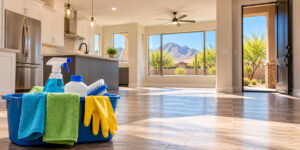
Moving into a new home is exciting, but it is also one of the best opportunities to clean the property thoroughly. Empty

Travertine is a natural fit for many Phoenix homes. Its warm tones work well on indoor floors, patios, showers, walkways, and pool